

Famous horses have played critical roles, from battlefields to racetracks and even as beloved Hollywood actors, leaving their hoofprints throughout history. Below are just some renowned equines whose legacies have endured the test of time.
Test your knowledge of famous equines below!
1.) Famous Horses Who Made History
Bucephalus – The Loyal Steed of Alexander the Great
Bucephalus symbolized loyalty and courage and was known for his strength and temper. Purchased by a 13-year-old Alexander, he gained the untamed horse’s trust and accompanied Alexander the Great through numerous conquests. According to legend, Alexander founded the city of Bucephala in his horse’s honor.
Marengo – Napoleon’s Companion
This small but resilient horse was named after the Battle of Marengo, where Napoleon emerged victorious. Marengo carried the French emperor in several key battles and was wounded at least 8 times. He was known to gallop 80 miles in just five hours and lived until the age of 38.
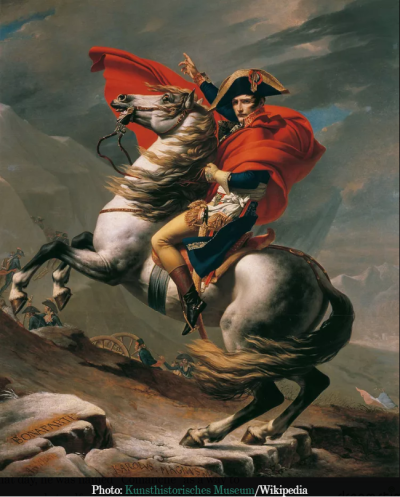
Napoleon Bonaparte Riding Marengo into Battle
Marengo carried Napoleon through several key battles and was wounded at least eight times in service.
Comanche – Survivor of the Battle of Little Bighorn
Comanche was Captain Myles Keogh’s mount and served in the 7th Cavalry during the infamous Battle of the Little Bighorn in 1876. Despite being severely wounded, Comanche was the only animal found alive after the battle in a ravine two days later. Following his recovery, he lived a peaceful retirement, symbolizing endurance.
2.) Conquering the Racetrack
Seabiscuit – An Underdog’s Tale
Seabiscuit’s story is about overcoming adversity. He was initially dismissed as a lazy and undersized horse. In fact, he lost all 17 races in his first year of racing. Seabiscuit rose to fame by defeating War Admiral, the 1937 Triple Crown winner, in a historic race. Seabiscuit symbolized hope during the Great Depression, proving perseverance can lead to greatness.
Secretariat – Thoroughbred Racehorse and Sire
A powerful chestnut Thoroughbred, Secretariat set records for the fastest time in all three races of the Triple Crown (the Kentucky Derby, Preakness Stakes, and Belmont Stakes) despite a slow start early in his racing career. Over 50 years later, his records have yet to be broken. After retiring at the age of 3, Secretariat sired over 650 named foals, including several Stakes winners and champion broodmares.
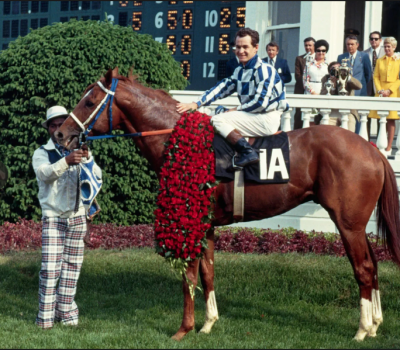
Secretariat 1973 Kentucky Derby Winner
Secretariat set records in all three Triple Crown races in 1973 that have not been broken in over 50 years.
Man o’ War – The Greatest Racehorse of All Time
Voted the Greatest American Racehorse of the 20th Century by Sports Illustrated, ESPN, The Blood-Horse, and the Associated Press, and recognized as Outstanding Athlete of the Year by the New York Times alongside Babe Ruth. Man o’ War was a chestnut Thoroughbred known for his wild temper. He retired at the age of 3 and was a successful stud until his death at age 30.
3.) Conquering Hollywood
Trigger – Movie Star Fame
As most baby boomers will remember, Trigger was the palomino ridden by Roy Rogers in film and on television. It is said that Trigger knew over 150 tricks and was even housebroken. Roy and Trigger were so bonded that Trigger was preserved after his death. Since 2021, Trigger has been displayed in Fort Worth, Texas’s John Wayne Museum Experience gift shop.
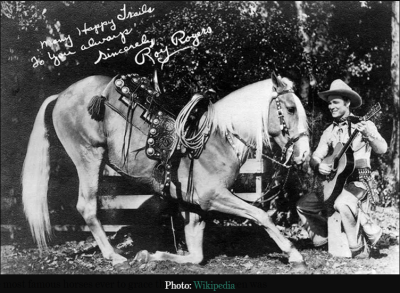
Trigger and Roy Rogers Signed Publicity Photo
Trigger knew over 150 tricks and was so bonded with Roy Rogers that he was preserved after his death.
Mister Ed – The Talking Horse
Born in 1949, Mr. Ed was actually named Bamboo Harvester. Like Trigger, he was a palomino. He portrayed the beloved talking horse starting in 1961 as the title character until 1966. Bamboo was also known for diva-like behavior. If he was finished shooting for the day, he would walk off the set.
The Pie – Elizabeth Taylor’s Co-Star
In 1944, a chestnut Thoroughbred named King Charles played alongside Elizabeth Taylor in National Velvet as The Pie. After filming, King Charles was given to Taylor as a birthday present.
Learn About Other Famous Horses in TV Shows and Movies
These horses by no means represent all the famous horses in history. But they are a brief snapshot of equines who played enduring roles, from battlefields to racetracks and the silver screen.
What the Greatest Horses in History Had in Common
The horses above were exceptional for different reasons, including temperament, speed, endurance, and loyalty. But every one of them shared something practical: they were handled, touched, and groomed daily by the people responsible for them. This consistent physical contact was not incidental. It was how trust was built, how health was monitored, and how the relationship between horse and handler was maintained at the highest level.
Bucephalus was known for his fierce temperament with strangers but responded only to Alexander. Marengo endured eight battle wounds and kept performing. Secretariat’s coat was monitored obsessively by his handlers in the weeks before each Triple Crown race. In each case, the horse’s condition and the human-horse relationship were inseparable.
Grooming the Horses in Your Care
Your horse may not be carrying a general into battle or breaking track records, but the same principle applies. Regular grooming is the most consistent form of hands-on communication between horse and owner. It is how you monitor coat condition, skin health, and early signs of soreness or sensitivity, and it is how your horse learns that your touch means something calm and deliberate.
During shedding season especially, a horse that is not groomed regularly will carry dead coat longer, sweat more under saddle, and be harder to read in terms of condition changes beneath the surface. Removing the loose undercoat efficiently is not just cosmetic. It is part of managing the horse’s comfort through the seasonal transition.
The 8″ EquiGroomer removes loose hair and dead coat across the full body, including legs, belly, and the face, without scraping or pulling. The micro-barbed blade works in the direction of coat growth, so horses that are sensitive to grooming tools typically relax within the first few passes. Most owners see a significant coat improvement within the first session, with horses standing quietly through areas they previously moved away from.